
🔊 Listening our way around the Osaka Loop
Let your ears be your guide
Every station on Osaka’s Loop Line has its own departure jingle, or hasshan merodi (発車メロディ), a 5-10 second tune that signals the train is about to leave the station. Tourists often notice the jingles but they might not know the history or local connections to each station.
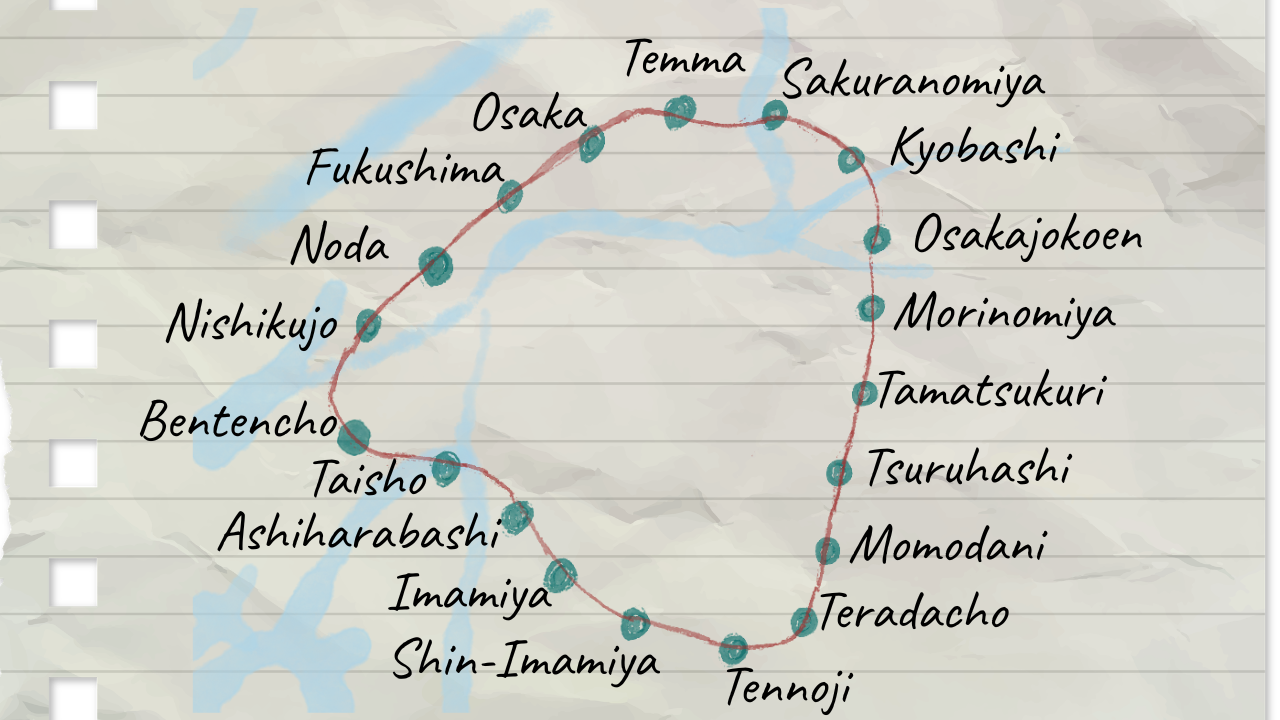
In this special interactive Soundscape, you can browse through the stations and listen at your own pace. Click on any of the 19 stations below to hear a recording of the full station stop, from the moment the train doors open to the moment they close. You’ll hear platform announcements, footsteps, the jingle, and the sound of Osaka’s Loop Line pulling away. Plus, all about learn the reasoning for each jingle choice. Some may surprise you!
Like a Pair of Cherries
Sakuranomiya Station's departure jingle is "Sakuranbo" (さくらんぼ) one of the signature songs of Ai Otsuka (an Osaka native). It's also one of her signature songs.
It's inspired by the cherry blossoms along the Okawa River, which runs near this station. One of my favorite lines in the song is, "Side by side, you and me, like a pair of cherries."
Old MacDonald had a...Takoyaki Stand?
Kyobashi Station's departure jingle will sound familiar to a lot of visitors -- it is set to the tune of "Old MacDonald Had a Farm," but with entirely different lyrics.
The "Osaka Umaimon Song" was written by local nursery school teachers, originally as a song and dance for children.
"Umaimon" is Osaka dialect for "delicious." The lyrics list the city's signature foods — takoyaki, dumplings, okonomiyaki, pork buns — and end with a shouted "nandeyanen?!" (why?!), a classic Osaka expression, sung in an exaggerated, comic way.
JR West chose it for Kyobashi specifically because the area is known for its food — a jingle that's essentially an edible advertisement for the neighborhood you're about to step into.
There's a War Horn Here
Osakajokoen Station's jingle doesn't sound like the rest of the line thanks to the deep, breathy blast of a horagai (法螺貝), a conch shell historically used by samurai as a battlefield signal.
It's a direct reference to the Siege of Osaka, the early 17th-century conflict fought at Osaka Castle, just steps from this station. Where every other jingle on the loop reaches for pop songs, folk tunes, or children's melodies, this one reaches back centuries — folding the actual sound of a battlefield signal into a train departure chime.
I Saw a Bear
Morinomiya Station's departure jingle is "Mori no Kuma-san" (森のくまさん) — "The Bear in the Forest" — a well-known Japanese children's call-and-response song.
The choice comes from the station's name: 森ノ宮 (Morinomiya), opens with 森 (mori) means "forest." JR West chose to capitalize on that concept: a forest-named station, playing a lighthearted song about being in one.
Windows that Sing
Tamatsukuri Station on Osaka's Loop Line plays a departure jingle that sounds like "Mary Had a Little Lamb" — and I was so surprised by the reason!
The station is attached to a building that houses a nursery school. The windows on the school's second floor were installed at different heights so children could look out of them — and the last few windows happen to fall in nearly the same pattern as the notes of "Mary Had a Little Lamb." The jingle echoes the windows!
A Yodel About Meat
Tsuruhashi Station's departure jingle is "Yodel Tabehodai" (ヨーデル食べ放題) — "All-You-Can-Eat Yodel" — a novelty song by comic performer Katsura Jakusaburo with the Manpuku Brothers, sung in an exaggerated Tyrolean yodel style, about the joys of an endless meat buffet.
The connection: Tsuruhashi is one of Osaka's biggest yakiniku (Japanese-Korean BBQ) districts, packed with grill restaurants — commuters often say the whole station smells like grilled meat!
Drinking and Singing About It
Momodani Station's departure jingle is "Sake to Namida to Otoko to Onna" (酒と泪と男と女) — "Sake, Tears, Men and Women" — by singer Eigo Kawashima. It's one of his signature songs.
The connection is personal: before his death, Kawashima owned and frequented a bar near this station. The jingle is a local's song, chosen for the neighborhood he actually spent his time in.
Life Goes On
Teradacho Station's departure jingle is "Life Goes On" by In-sist (韻シスト), an Osaka hip-hop and soul group — but unlike every other jingle on this line, it wasn't a song JR West found and repurposed. It was written specifically as the theme song for the Osaka Loop Line Modernization Project.
This Should Ring a Bell
Tennoji Station's departure jingle is "Ano Kane wo Narasu no wa Anata" (あの鐘を鳴らすのはあなた) — "You're the One to Ring That Bell" — a 1972 song originally performed by Akiko Wada, a major figure in Japanese entertainment who was born and raised in Tennoji Ward.
The jingle isn't just a hometown nod. Tennoji Station is a short walk from Shitennoji Temple, one of Japan's oldest Buddhist temples, famous for its bell towers and its New Year's Eve bell-ringing ceremony. The chiptune arrangement even weaves in the sound of a chiming bell — a literal echo of the temple's own.
A Whole New World
Shin-Imamiya Station's sits right beside Shinsekai, whose name literally translates to "New World." So the departure jingle here is a portion of Antonín Dvořák's Symphony No. 9, "From the New World."
For One of the Lucky Seven
Imamiya Station's departure jingle is "Daikoku-sama" (大黒様), a traditional Japanese children's song about the god of wealth and good fortune.
The station sits near the Okuninushi Shrine, in which there is a wooden carving of Daikoku-sama , one of the Seven Lucky Gods. The shrine is affectionately known as “Kiss no Daikoku-San” in Osaka.
Driven by Drumming
Ashiharabashi Station's departure jingle is "Matsuri," performed by Ikari (怒) — a taiko drum ensemble whose name means "anger."
Ashiharabashi's neighborhood has a long history in leather manufacturing and traditional taiko drum making — trades historically tied to the local Naniwa community, including groups who faced generations of discrimination. Ikari was formed by youth from that community, choosing their name deliberately: a way of channeling historical hardship into art, rather than around it.
A Little Piece of Okinawa
Taisho Station's departure jingle is "Tinsagu nu Hana" (てぃんさぐぬ花), a traditional Okinawan folk song. The choice reflects the neighborhood itself: Taisho has one of Osaka's largest Okinawan communities, built up over generations.
The jingle is a nod to that history — Okinawan culture, sound, and identity, carried into the middle of Osaka.
For the Love of Trains
Bentencho Station's departure jingle is the American folk standard "I've Been Working on the Railroad." The song is also a popular children's song in Japan, known as "The Tracks Go On Forever."
There used to be a train museum right next to this station, so the song choice was pretty obvious then. The museum has since closed, but the jingle remains.
Like Mom and Apple Pie
Nishikujo Station's departure jingle is "American Patrol," a popular American march written in 1885 that combines musical elements from Dixie, Yandkee Doodle Dandy, and others.
Glen Miller created a big band swing arrangement that was very popular and unmistakably American. The melody acts as signage...because Nishikujo is the transfer station for Universal Studios Japan.
Market Day Song
Noda Station's departure jingle is a 19th-century Russian folk song called "Одна неделька" ("One Week") — and the reason it was chosen has nothing to do with Russia at all.
The song describes the main character's the daily activities, and in its Japanese translation, Sunday is the day she goes to the market. It just so happens that Noda Station is the closest station to one of the city's largest markets, the Osaka Municipal Central Wholesale Market.
Round and Round
Fukushima Station's departure jingle is "Musōbana" (夢想花), a 1978 song by Hiroshi En, chosen for one line in particular: "Go around and around..."
It's a fitting choice for a station on the Osaka Loop Line, a train route that, true to its name, never really ends — it just keeps circling. The lyric and the line share the same shape.
Blooming Fireworks
Temma Station's departure jingle is "Hanabi" (花火) — "Fireworks" — by aiko, an Osaka-native singer. The song was inspired by the Tenjin Festival, one of Japan's largest and oldest, held every summer at Osaka Tenmangu Shrine — a short walk from this station.
"We watched fireworks blooming in a flash of light, surely this summer is far from over," is one line in the chorus.
A Hometown Love Story
Osaka Station's departure jingle is "Yappa Suki Yanen" (やっぱ好きやねん) — "I Still Love You" — by Takajin Yashiki, a singer born and raised in Osaka. The song's chorus is sung in the city's own dialect, distinct from standard Japanese.
It's a fitting anchor for the busiest station on the loop: a hometown song, in the hometown voice, sung by someone who was from here. The stop here is the longest in the loop - much longer than any of the other stops recorded.
Naturalist’s Notebook

Listen
There are plenty of other jingles and notification sounds playing on these platforms. How many different tunes do you hear? Can you figure out what they are communicating?

Ask
Besides the jingles, what sounds are similar to other public transportation systems you’ve ridden? What sounds are different?