
📝 Kayaking Between Icebergs
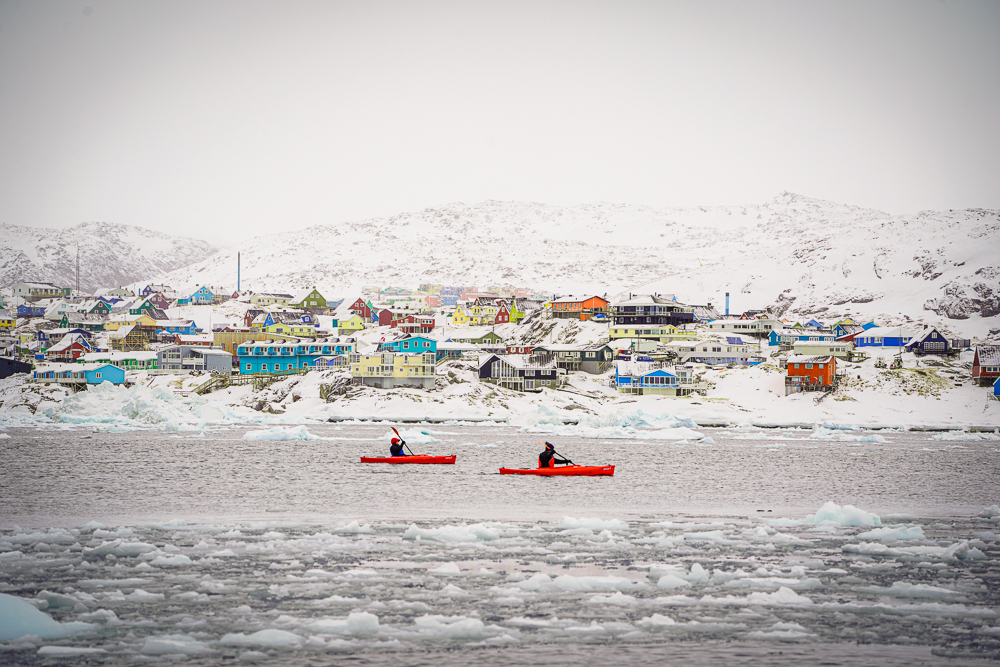
Once you arrive in Ilulissat, you won’t be able to take your eyes off of the icebergs. With their massive size, surprising colors, and ever changing shapes, watching them could be a full time sport.
The photographer in me wanted to get as close as possible and dreamt of what they must look like from different angles. Our boat tour provided that to an extent, plus some coffee and cookies, and shelter if you get too cold. But if you want to feel even closer, kayaking among the icebergs is the way to go.
qajaq
Qajaq (in English, spelled kayak) is an Inuit hunting and travel vessel that has been central to life in Greenland for more than 4,000 years and remains one of the strongest symbols of Inuit culture and resilience.
To be clear, you can’t get too close. The rule of thumb, our Inuk Adventures tour guide told us, is to keep away at a distance about twice its height. So if it is about 50 feet tall, stay about 100 feet away.
But even keeping our distance, kayaking between these massive ice sculptures was an incredible experience.
We were there in early May, and it was about 27F with light snow when we met at the harbor (and colder out on the water). My friend and I were joined by a couple, so it was a nice, small group.
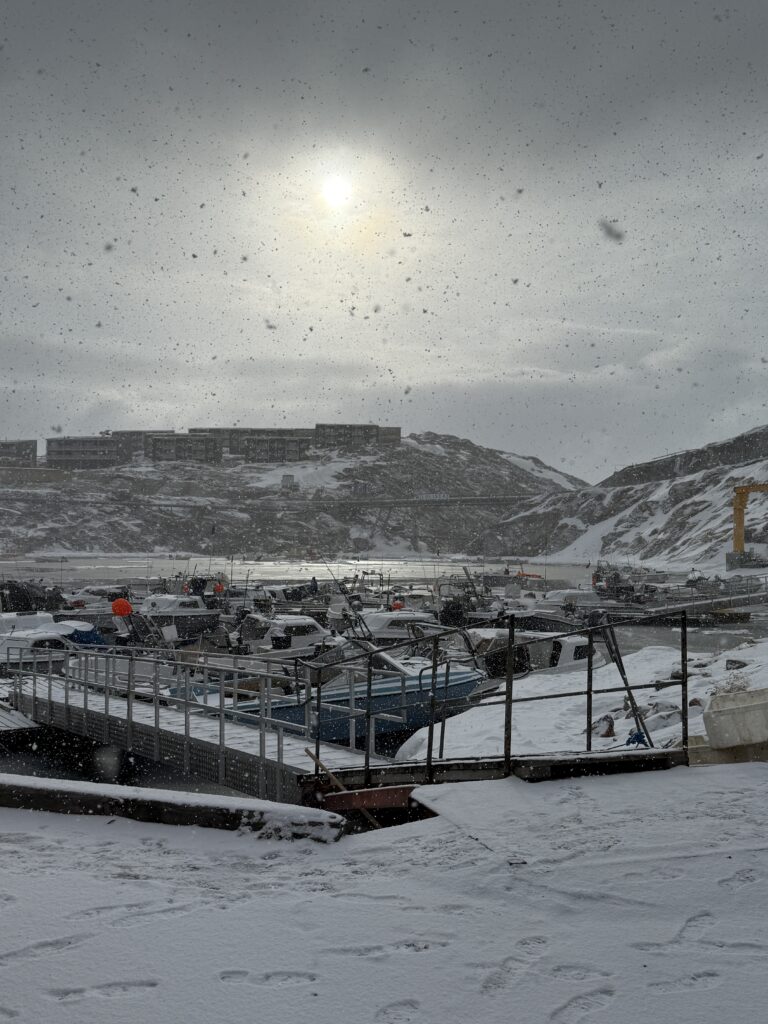 Snow greeted us before we ever reached the icebergs. Photo courtesy of Inuk Adventure.
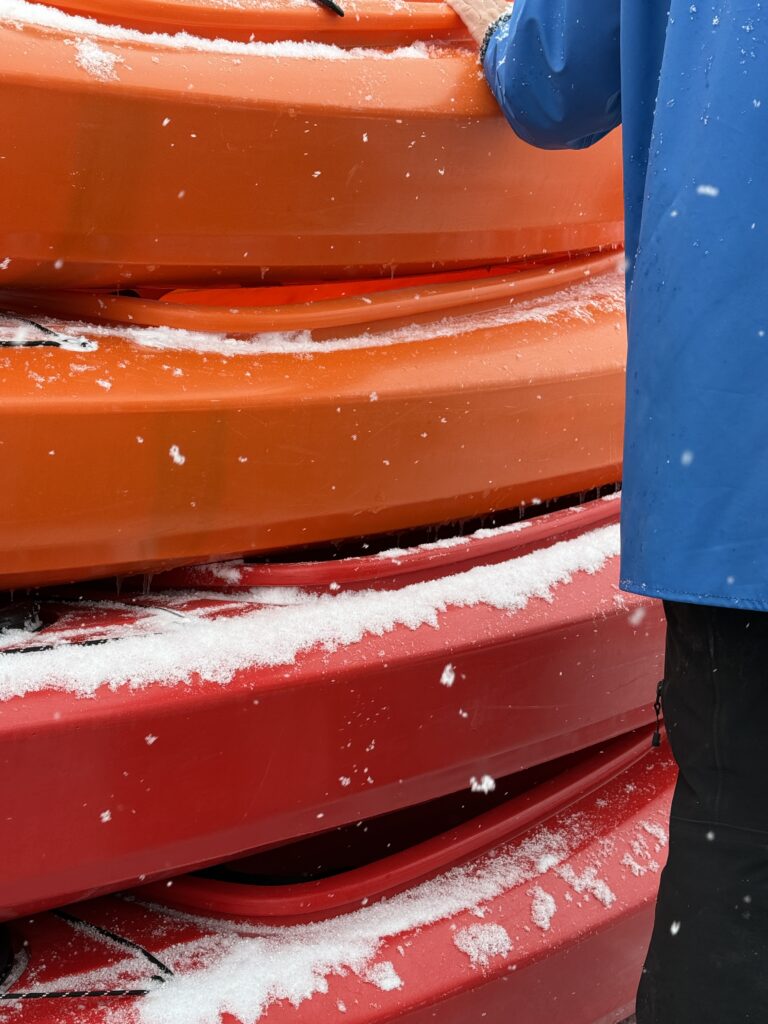 Fresh snow gathers on kayaks awaiting launch.
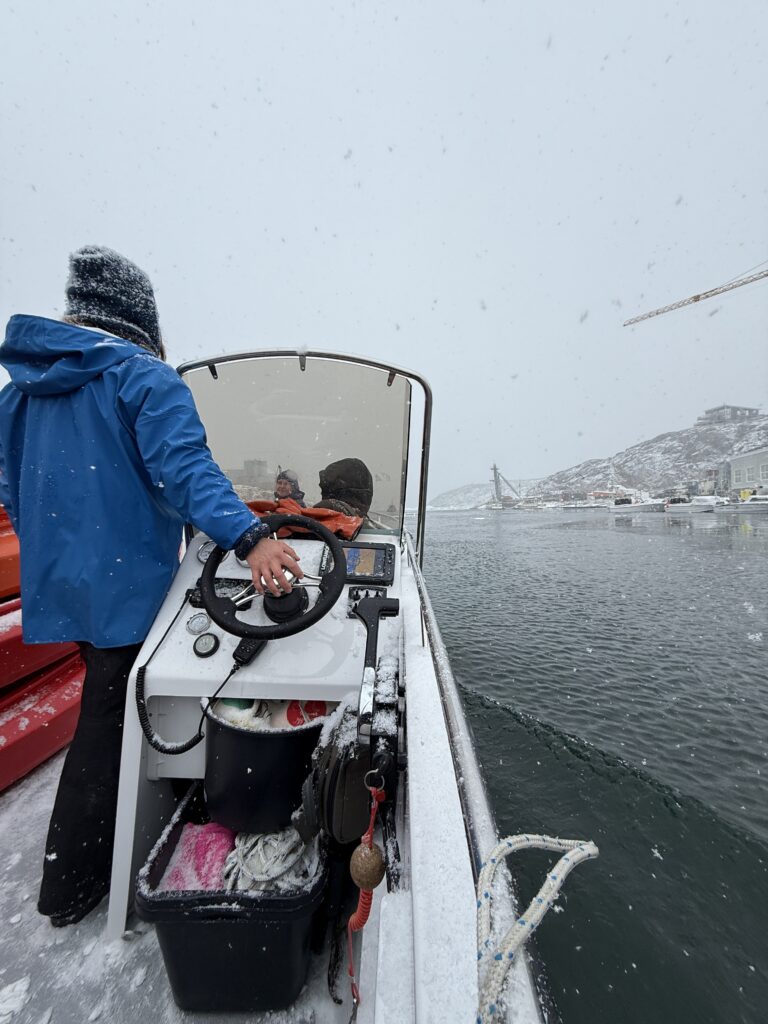 Our captain navigates toward the day’s launch site.
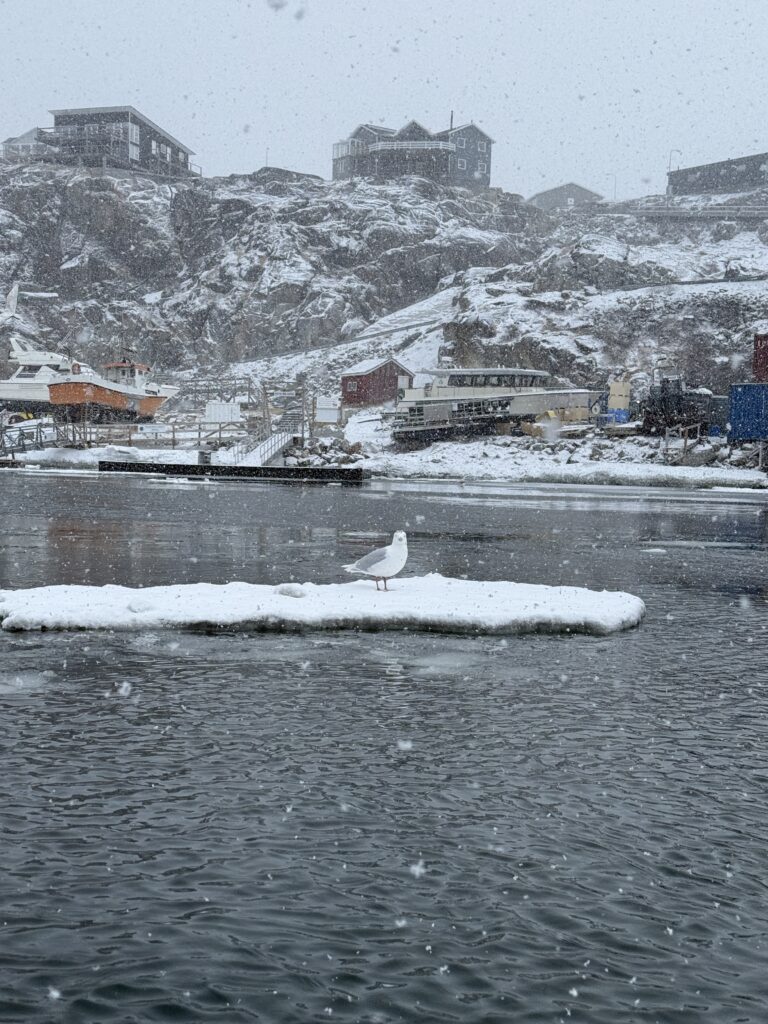 Even the resting places float in Greenland.
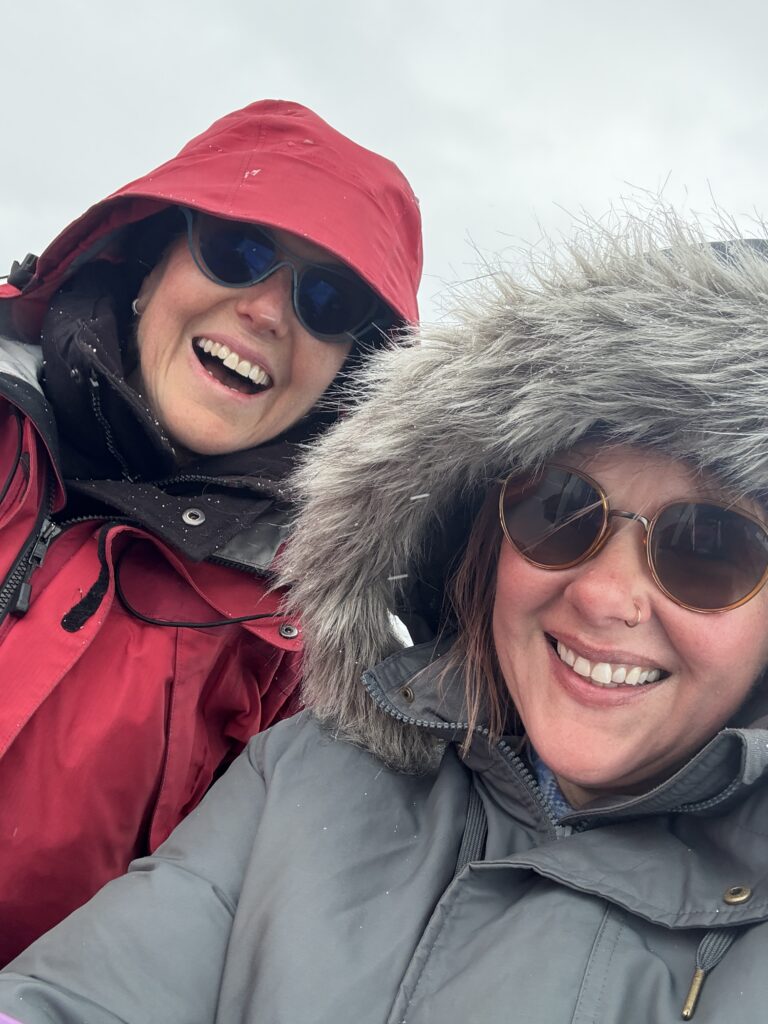 Ready for a morning among Greenland’s icebergs.
We piled into a small boat along with a stack of orange kayaks, navigated past parked fishing boats, lots of resting seagulls, and the large oil towers that stand sentry over the harbor, and made our way into the waters of Disko Bay. After about 20 minutes, our guide killed the engine and grinned. “It is time,” she said.
Side note: There should be a word for the sensation when a loud constant noise abruptly stops. That sudden absence of sound that rings in my ears while the last echos of engine noise dissipate into the horizon is like an announcement that something special is about to happen.
Now it was time to get into our dry suits. If you’ve never put on a dry suit, just know they are tight, constricting, and absolutely necessary on water this cold. Sitting still during the boat ride out, with wind on our faces, had made us pretty attached to our coats, so it was a true act of bravery to take off our outer layers to don the dry suits.
But once we got that suit on and into the kayaks, we forgot all about the temperature. We were free to explore, and so off we went. The couple kayaked often, and they brought a drone, so they promptly disappeared around a large iceberg on their own adventure. Laura and I were a little slower getting into our kayaks and in the water. But once we were in, we felt unstoppable.
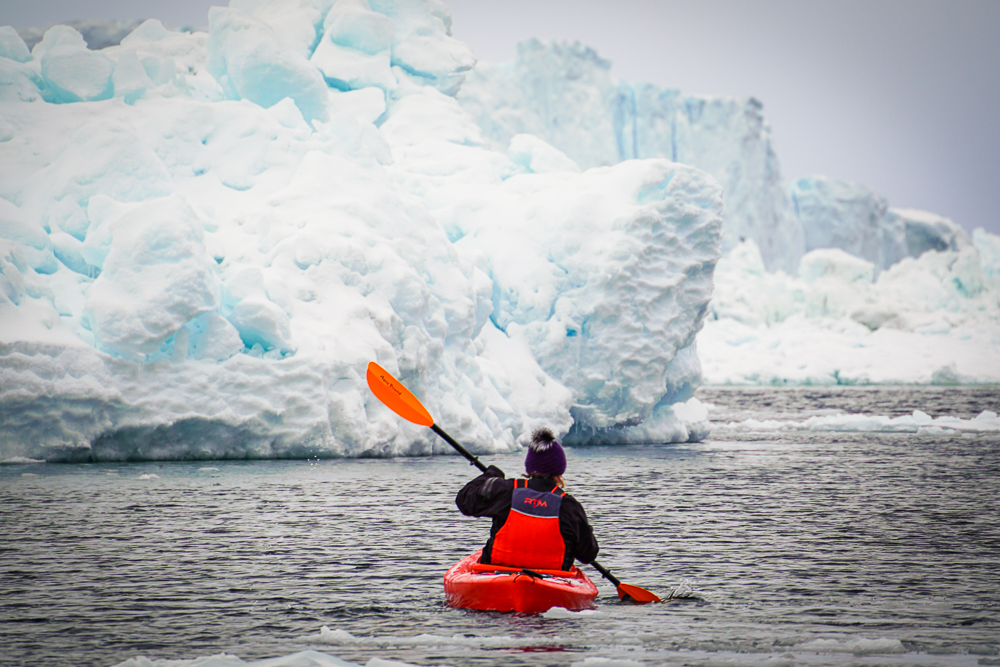 The scale of the ice becomes clear from water level. Photo courtesy of Inuk Adventure.
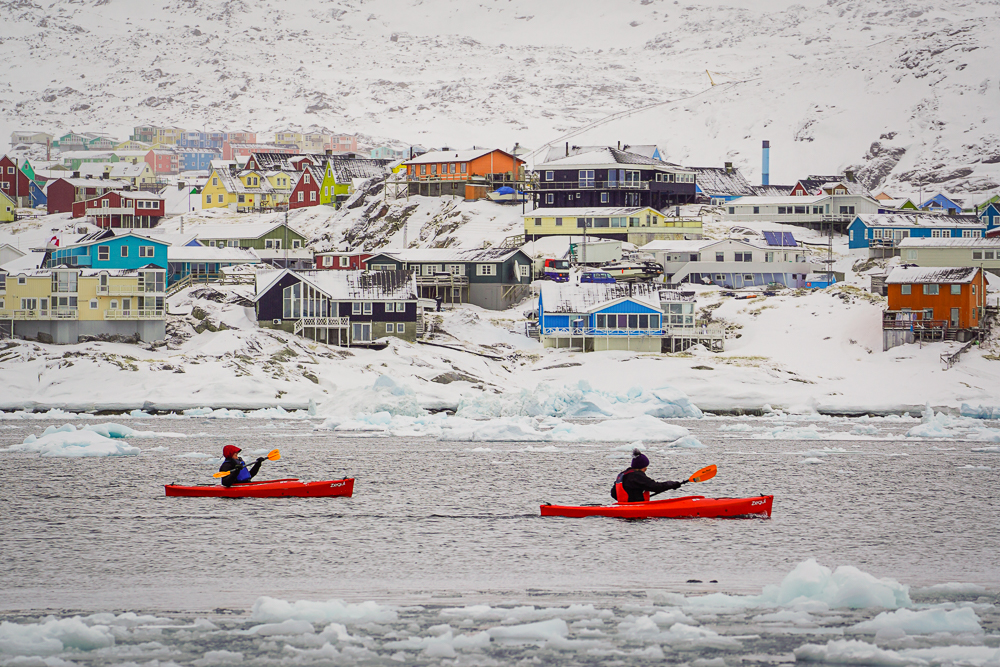 The town quickly gives way to open water and ice. Photo courtesy of Inuk Adventure.
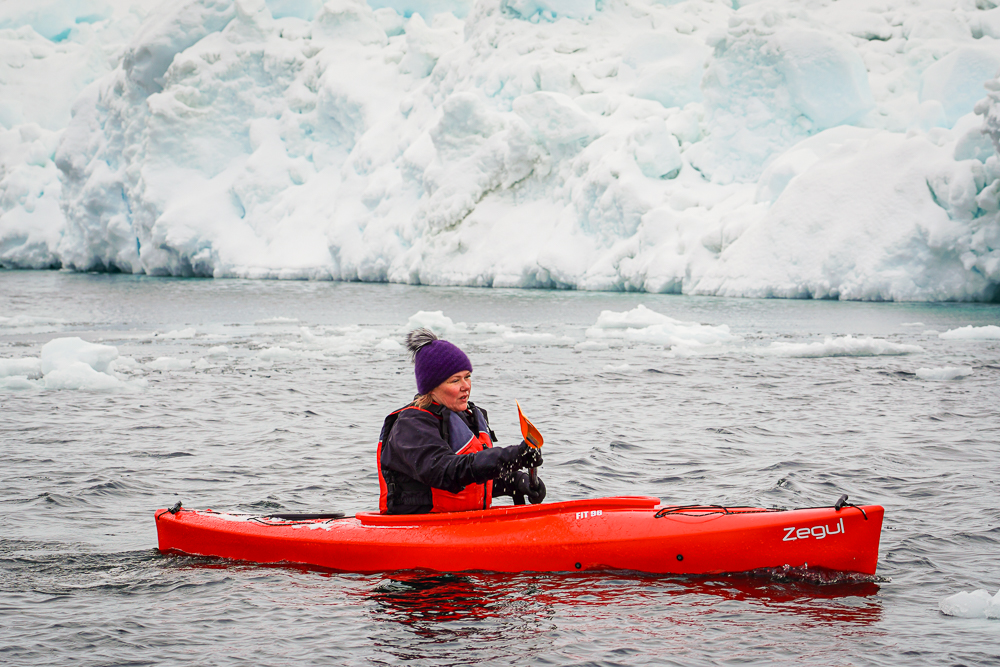 Focused on the rhythm of the paddle. Photo courtesy of Inuk Adventure.
The ink-black water was smooth and easy to navigate. The sea ice and bits of black ice made hollow thunks as they gently hit the side of our plastic kayaks. After paddling a bit, we’d pause to catch our breath, only to have it taken away by the views of towering skyscrapers of ice.
We spent a couple of hours on the water and it was perfect. By the time we got back into the boat and then back to the harbor we were cold, tired, and grinning from ear to ear. I would absolutely do this again.
Naturalist’s Notebook

Notice
Icebergs are rarely all white. Look for bands of blue compressed by centuries of snow, black streaks of windblown sediment, and pockets where meltwater pools like glass.

Listen
Stop paddling for a minute and just listen. You’ll hear silence first, but then the bay becomes surprisingly loud: dripping meltwater, distant cracks echoing across the fjord, the fizz of trapped air escaping ancient ice.

Ask
What is moving here besides you?
– The ice.
– The currents.
– The birds.
– Even the mountains, ever so slowly.